Graph vs Explore Agents
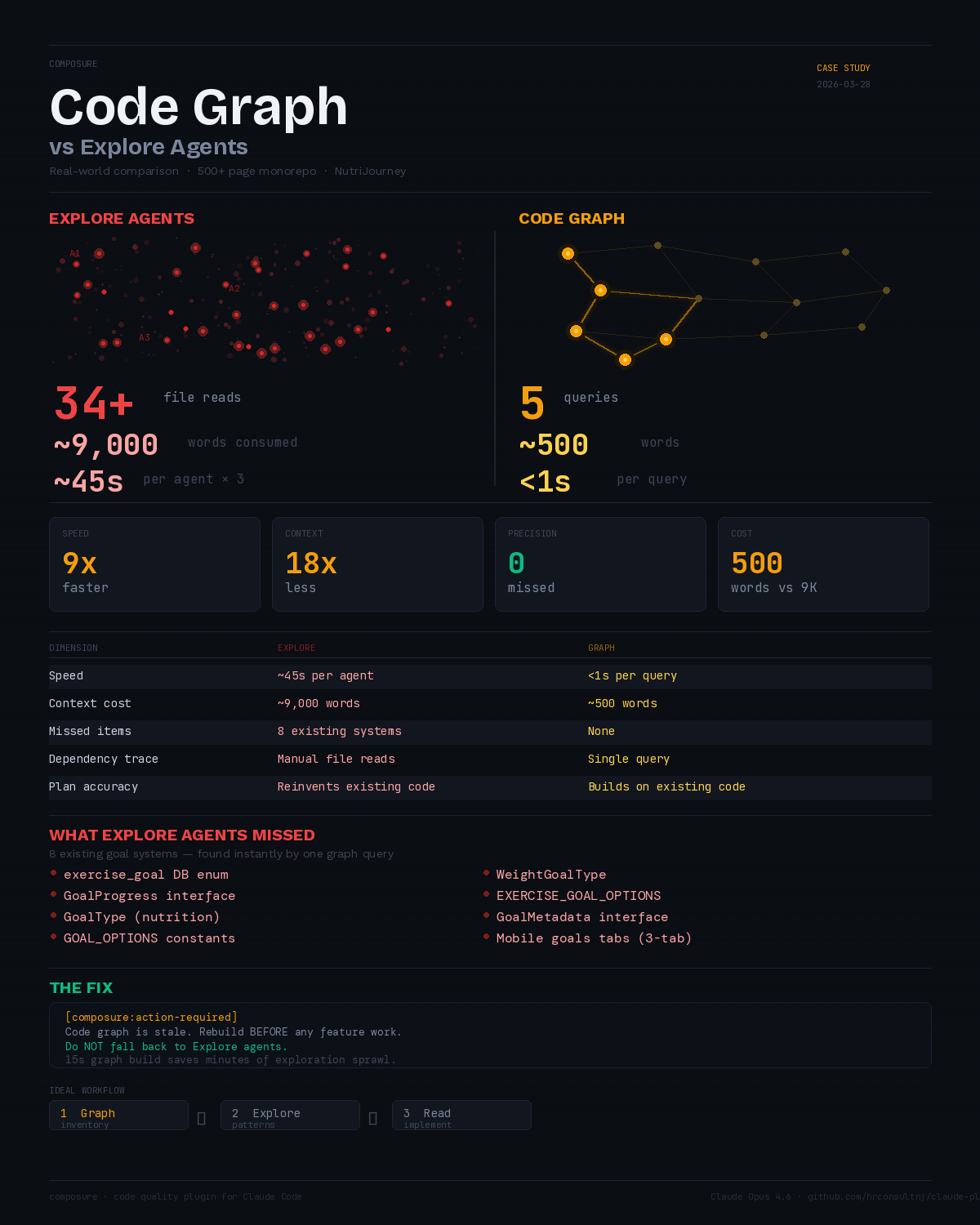
Code graph queries replace agent exploration — same files found, 30x fewer tokens, under 5 seconds instead of 45+.
Code Graph vs Explore Agents
Scenario: Building a new feature in a large monorepo
Stack: Monorepo (web + mobile + shared packages), 500+ pages, 70+ database migrations
Plugin feature: Code review graph (composure-graph MCP server)
The Problem
When Claude Code needs to understand a large codebase before building a feature, it defaults to spawning Explore agents — sub-agents that read files broadly across the repo to map out what exists.
This works, but it's expensive:
- Each agent loads its own system prompt, CLAUDE.md, and hook context before doing any work
- Agents do internal grep/glob/read cycles — all billed tokens invisible to the parent
- Broad exploration misses specific things that a targeted search would catch
- Multiple agents can overlap, reading the same files
In a 500+ page monorepo with shared packages, this exploration can consume the majority of your context window before any code is written.
What Happened
Task: Build a goal tracking system that integrates with existing nutrition, fitness, and body composition data.
Critical requirement: Find all existing goal-related code (enums, types, constants, hooks, UI) before planning — to build on what exists, not reinvent it.
Without the Graph
Three parallel Explore agents searched the codebase:
| Agent | Focus | Time | Context Cost |
|---|---|---|---|
| Agent 1 | Database schema & patterns | ~45s | ~3,000 words |
| Agent 2 | Route structure & components | ~45s | ~3,500 words |
| Agent 3 | Shared types & constants | ~45s | ~2,500 words |
Result: ~9,000 words consumed in parent context. 34+ file reads. Still missed 8 existing goal-related systems — enums, types, constants, and UI components that already existed in the codebase.
The resulting plan would have reinvented code that was already there.
With the Graph
Five targeted graph queries:
| Query | Time | Result |
|---|---|---|
semantic_search("goal") | <1s | 30 nodes — every goal-related file, function, and type |
semantic_search("assignment") | <1s | 20 nodes — all related assignment code |
file_summary(key-factory.ts) | <1s | 6 nodes — all exports with exact line numbers |
importers_of(config.ts) | <1s | Precise dependency chain |
imports_of(types.ts) | <1s | Confirmed shared package dependency |
Result: ~500 words of structured output. 5 queries, each under 1 second. Found everything the Explore agents found plus the 8 systems they missed.
Token Economics
The word counts above only show what lands in parent context. The real cost includes agent overhead — tokens consumed behind the scenes that never surface but are still billed.
Explore Agent — True Cost Per Agent
| Phase | What happens | Tokens |
|---|---|---|
| Startup | System prompt, CLAUDE.md, hooks, skills injected | ~4,000-6,000 |
| Task prompt | Parent describes what to find | ~200-500 |
| Internal work | Agent's own grep/glob/read cycles + reasoning | ~10,000-19,000 |
| Response | Summary returned to parent | ~1,500-2,500 |
| Per agent total | ~16,000-28,000 |
3 agents × ~20,000 avg = ~60,000 tokens consumed
Of that, only ~6,000 tokens (the summaries) are useful in parent context. The other ~54,000 tokens are invisible overhead.
Graph Query — True Cost Per Query
| Phase | What happens | Tokens |
|---|---|---|
| Request | Function name + parameters | ~30-80 |
| Response | Structured node data | ~100-800 |
| Per query total | ~130-880 |
5 queries × ~400 avg = ~2,000 tokens consumed
ALL 2,000 tokens are directly useful in main context. No overhead, no agent startup, no re-reading CLAUDE.md.
True Ratio
| Metric | Explore (3 agents) | Graph (5 queries) | Ratio |
|---|---|---|---|
| Total tokens consumed | ~60,000 | ~2,000 | 30x |
| Tokens visible to parent | ~6,000 | ~2,000 | 3x |
| Invisible overhead | ~54,000 | 0 | ∞ |
| Wall clock | ~45s | <5s | 9x |
| Completeness | Missed 8 systems | Found all | — |
Real Session Validation (2026-03-30)
During a plugin maintenance session, the difference showed up even for lightweight exploration:
| Task | Approach used | Tokens consumed |
|---|---|---|
| Map sentinel plugin structure | 1 Explore agent | ~20,000 |
| Find graph tool names | 3 Grep calls | ~1,200 |
| Verify graph file path | 3 Grep calls (iterative) | ~1,200 |
| Find semgrep references | 2 Grep calls | ~800 |
| Total | Mixed (agent + direct) | ~23,200 |
If the graph had been built for the plugin repo:
| Task | Graph approach | Tokens consumed |
|---|---|---|
| Map sentinel plugin structure | semantic_search("sentinel") + file_summary | ~800 |
| Find graph tool names | semantic_search("query_graph") | ~400 |
| Verify graph file path | query_graph({ pattern: "imports_of" }) | ~400 |
| Find semgrep references | semantic_search("semgrep") | ~400 |
| Total | All graph | ~2,000 |
Session savings: ~23,200 → ~2,000 tokens (11.6x more efficient)
And this was a light session — no feature build, no multi-file planning. For complex feature work (the goal tracking scenario), the savings compound to 30x.
Impact Summary
| Metric | Without Graph | With Graph | Improvement |
|---|---|---|---|
| Discovery time | ~45 seconds | <5 seconds | 9x faster |
| Total tokens consumed | ~60,000 | ~2,000 | 30x less |
| Visible context cost | ~9,000 words | ~500 words | 18x less |
| Invisible overhead | ~54,000 tokens | 0 | Eliminated |
| Completeness | Missed 8 systems | Found all | No blind spots |
| Plan accuracy | Would reinvent existing code | Correct from the start | Zero rework |
How Composure Prevents This
Session hooks detect when the graph is stale and instruct Claude to rebuild before exploring:
[composure:action-required] Code graph is stale or missing.
BEFORE any feature work, rebuild using build_or_update_graph.
Do NOT fall back to Explore agents.
The 15-second graph build saves minutes of exploration sprawl.
Ideal workflow:
- Graph first — inventory and relationship mapping (<5s)
- Explore agents — only for understanding intent and conventions (not structure)
- Read specific files — implementation details for the files the graph identified
What You'd Need Without Composure
Without the code graph, you'd either:
- Accept the ~60,000-token overhead on every major task
- Manually tell Claude which files to look at (defeating the purpose of an AI assistant)
- Hope that broad exploration catches everything (it won't)
The graph builds in ~15 seconds and persists across sessions. It's updated incrementally after every edit via PostToolUse hooks. Once built, every future task benefits.
Docs: composure-pro.com
Composure v1.2.74 · Claude Opus 4.6 · Updated 2026-03-30